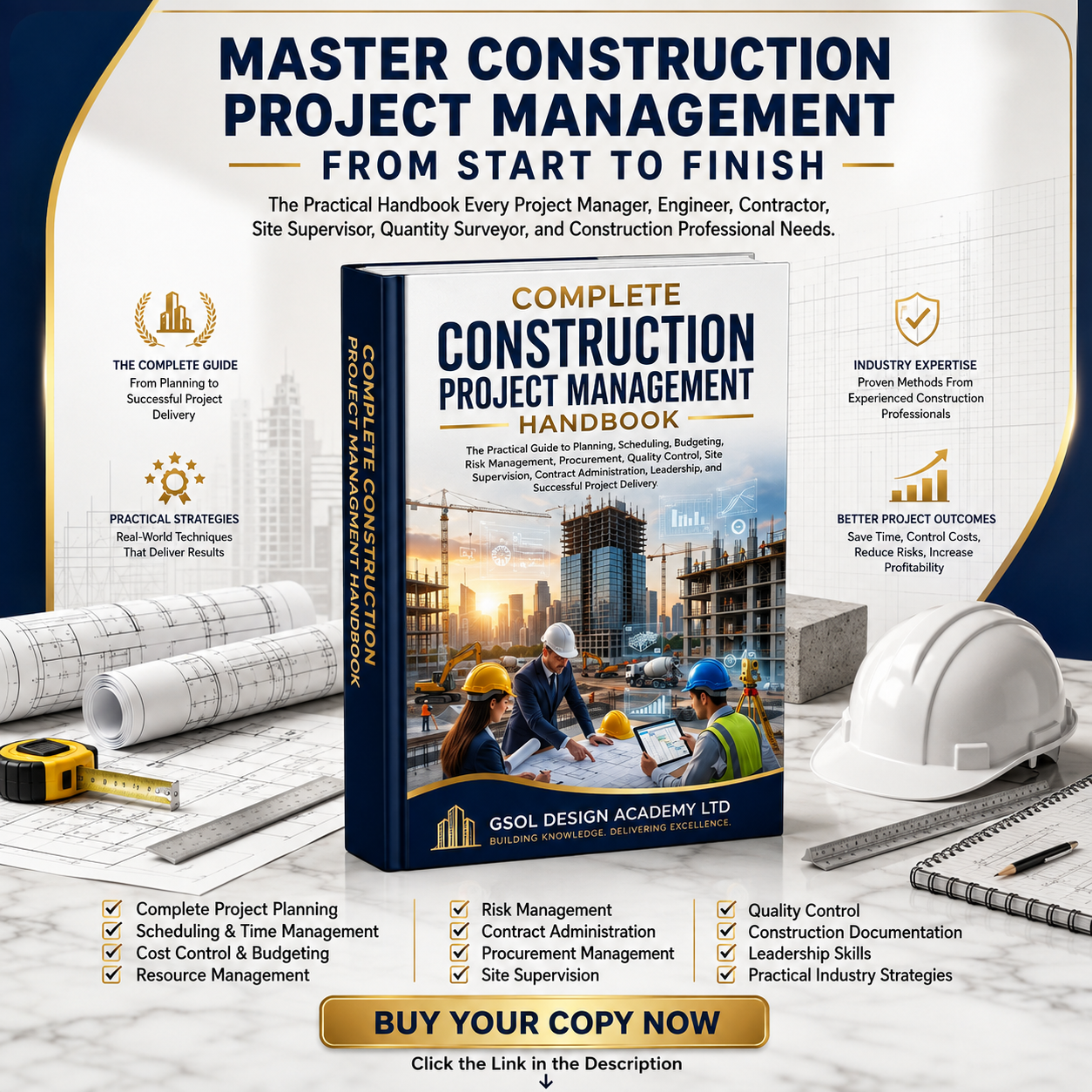
COMPLETE CONSTRUCTION PROJECT MANAGEMENT HAND BOOK AND TOOL KIT

COMPLETE CONSTRUCTION PROJECT MANAGEMENT HANDBOOK
International Standard Professional Edition
Complete Construction Project Management Handbook is a practical, step-by-step guide designed to help construction professionals, students, contractors, engineers, architects, and project managers successfully plan, execute, monitor, and deliver construction projects on time, within budget, and to the highest quality standards. Learn proven project management techniques, scheduling, budgeting, risk management, procurement, site coordination, quality control, and best practices used on real construction projects.
PREVIEW THIS BOOK BELOW BEFORE PURCHASE:
TABLE OF CONTENT:
CHAPTER 1: INTRODUCTION TO CONSTRUCTION PROJECT MANAGEMENT
1.1 Understanding Construction Project Management
1.1.1 Definition of Construction Project Management
1.1.2 Principles of Project Management
1.1.3 Nature of Construction Projects
1.1.4 Construction Management Framework
1.2 Construction Industry Overview
1.2.1 Global Construction Industry
1.2.2 Construction Sectors and Categories
1.2.3 Industry Stakeholders
1.2.4 Current Industry Challenges and Opportunities
1.3 Importance of Construction Project Management
1.3.1 Project Coordination
1.3.2 Time, Cost and Quality Control
1.3.3 Risk Reduction
1.3.4 Productivity and Efficiency
1.4 Project Success and Professional Ethics
1.4.1 Project Success Criteria
1.4.2 Critical Success Factors
1.4.3 Professional Ethics and Integrity
1.4.4 Responsibilities of Construction Professionals
CHAPTER 2: PROJECT LIFE CYCLE AND STAKEHOLDER MANAGEMENT
2.1 Construction Project Life Cycle
2.1.1 Project Initiation
2.1.2 Planning Stage
2.1.3 Execution Stage
2.1.4 Monitoring and Control
2.1.5 Project Closeout
2.2 Stakeholder Management
2.2.1 Stakeholder Identification
2.2.2 Stakeholder Analysis
2.2.3 Stakeholder Mapping
2.2.4 Stakeholder Engagement Strategies
2.2.5 Communication with Stakeholders
2.3 Project Governance
2.3.1 Governance Structures
2.3.2 Decision-Making Processes
2.3.3 Accountability and Transparency
CHAPTER 3: PROJECT PLANNING AND FEASIBILITY
3.1 Feasibility and Project Development
3.1.1 Feasibility Study Principles
3.1.2 Economic Feasibility
3.1.3 Technical Feasibility
3.1.4 Environmental Feasibility
3.1.5 Legal and Regulatory Feasibility
3.2 Site Investigation and Project Brief
3.2.1 Site Analysis
3.2.2 Geotechnical Investigation
3.2.3 Site Constraints
3.2.4 Project Brief Preparation
3.3 Planning Framework
3.3.1 Scope Definition
3.3.2 Project Objectives
3.3.3 Work Breakdown Structure (WBS)
3.3.4 Project Charter
3.3.5 Project Documentation
CHAPTER 4: CONSTRUCTION SCHEDULING AND TIME MANAGEMENT
4.1 Principles of Scheduling
4.1.1 Time Management Fundamentals
4.1.2 Activity Identification
4.1.3 Sequence Development
4.2 Scheduling Techniques
4.2.1 Gantt Charts
4.2.2 Bar Charts
4.2.3 Milestone Scheduling
4.2.4 Network Diagrams
4.3 Critical Path and Advanced Scheduling
4.3.1 Critical Path Method (CPM)
4.3.2 Program Evaluation and Review Technique (PERT)
4.3.3 Float and Slack Analysis
4.3.4 Schedule Compression
4.4 Delay and Recovery Management
4.4.1 Delay Identification
4.4.2 Delay Analysis
4.4.3 Extension of Time Claims
4.4.4 Recovery Planning
CHAPTER 5: COST MANAGEMENT AND PROJECT FINANCE
5.1 Construction Cost Fundamentals
5.1.1 Cost Components
5.1.2 Direct and Indirect Costs
5.1.3 Cost Drivers
5.2 Estimating and Budgeting
5.2.1 Cost Estimating Methods
5.2.2 Budget Preparation
5.2.3 Cost Planning
5.3 Financial Management
5.3.1 Cash Flow Forecasting
5.3.2 Financial Monitoring
5.3.3 Cost Reporting
5.3.4 Cost Control Techniques
5.4 Value Engineering and Optimization
5.4.1 Value Engineering Principles
5.4.2 Cost Optimization Strategies
5.4.3 Financial Risk Management
CHAPTER 6: CONTRACTS, PROCUREMENT AND TENDERING
6.1 Construction Contracts
6.1.1 Types of Contracts
6.1.2 Contract Documents
6.1.3 FIDIC Principles
6.1.4 Contractual Obligations
6.2 Procurement Systems
6.2.1 Traditional Procurement
6.2.2 Design and Build
6.2.3 Management Contracting
6.2.4 EPC and PPP Models
6.3 Tendering and Contractor Selection
6.3.1 Tender Documentation
6.3.2 Tender Procedures
6.3.3 Bid Evaluation
6.3.4 Contractor Selection
6.4 Contract Administration
6.4.1 Contract Management
6.4.2 Claims and Variations
6.4.3 Dispute Resolution
6.4.4 Arbitration and Mediation
CHAPTER 7: RISK, QUALITY, HEALTH AND SAFETY MANAGEMENT
7.1 Risk Management
7.1.1 Risk Identification
7.1.2 Risk Assessment
7.1.3 Risk Prioritization
7.1.4 Risk Mitigation Strategies
7.2 Quality Management
7.2.1 Quality Assurance (QA)
7.2.2 Quality Control (QC)
7.2.3 Inspection Procedures
7.2.4 Quality Documentation
7.3 Health, Safety and Environment (HSE)
7.3.1 Construction Safety Principles
7.3.2 Site Safety Procedures
7.3.3 Accident Prevention
7.3.4 Environmental Protection
7.3.5 Sustainable Construction Practices
CHAPTER 8: RESOURCE AND SITE MANAGEMENT
8.1 Labour and Workforce Management
8.1.1 Labour Planning
8.1.2 Workforce Productivity
8.1.3 Labour Relations
8.2 Materials and Equipment Management
8.2.1 Material Planning
8.2.2 Procurement and Storage
8.2.3 Equipment Selection
8.2.4 Plant Management
8.3 Site Management
8.3.1 Site Organization
8.3.2 Site Logistics
8.3.3 Site Supervision
8.3.4 Productivity Improvement
CHAPTER 9: DIGITAL CONSTRUCTION AND TECHNOLOGY
9.1 Construction Technology
9.1.1 Construction Software Applications
9.1.2 Digital Project Documentation
9.1.3 Project Tracking Tools
9.2 Building Information Modelling (BIM)
9.2.1 BIM Fundamentals
9.2.2 BIM Applications in Project Management
9.2.3 BIM Collaboration
9.3 Emerging Technologies
9.3.1 Drones and Survey Technology
9.3.2 Artificial Intelligence in Construction
9.3.3 Automation and Robotics
9.3.4 Smart Construction Systems
CHAPTER 10: LEADERSHIP, COMMUNICATION AND TEAM MANAGEMENT
10.1 Leadership in Construction
10.1.1 Leadership Styles
10.1.2 Decision-Making Skills
10.1.3 Emotional Intelligence
10.2 Communication Management
10.2.1 Communication Systems
10.2.2 Reporting Procedures
10.2.3 Presentation Skills
10.3 Team and Conflict Management
10.3.1 Team Building
10.3.2 Conflict Resolution
10.3.3 Negotiation Skills
10.3.4 Meeting Management
CHAPTER 11: PROJECT MONITORING, CONTROL AND CLOSEOUT
11.1 Project Monitoring and Performance
11.1.1 Progress Measurement
11.1.2 Performance Indicators
11.1.3 Earned Value Management (EVM)
11.2 Change and Performance Control
11.2.1 Change Management
11.2.2 Performance Tracking
11.2.3 Corrective Actions
11.3 Project Completion and Handover
11.3.1 Project Handover Procedures
11.3.2 Defects Liability Management
11.3.3 Final Documentation
11.3.4 Project Closeout
11.4 Post-Project Evaluation
11.4.1 Lessons Learned
11.4.2 Project Audits
11.4.3 Performance Review
CHAPTER 12: PRACTICAL CASE STUDIES AND PROJECT DOCUMENTS
12.1 Construction Case Studies
12.1.1 Residential Project Case Study
12.1.2 Commercial Project Case Study
12.1.3 Infrastructure Project Case Study
12.2 Practical Project Documentation
12.2.1 Project Plans
12.2.2 Risk Registers
12.2.3 Site Reports
12.2.4 Cost Reports
12.2.5 Progress Reports
12.3 Capstone and Professional Practice
12.3.1 Project Management Templates
12.3.2 Practical Exercises
12.3.3 Final Capstone Project
APPENDICES
Appendix A – Construction Project Management Forms
Appendix B – Site Inspection Checklists
Appendix C – Project Planning Templates
Appendix D – Contract and Tender Samples
Appendix E – Risk Assessment Templates
Appendix F – Construction Terminologies and Glossary
Appendix G – Acronyms and Abbreviations
Appendix H – References and Further Reading
This TOC is structured to international professional handbook standard and suitable for a premium Construction Project Management Handbook, training manual, or published reference book.